The Markers on the Camino de Santiago
Are you planning your first pilgrimage along the Portuguese route and worrying about getting lost? Don’t panic. The Camino Portugués, including all its stunning coastal, central, and spiritual variants, is exceptionally well-marked.
When you step onto the historical paths of the Portuguese Way of St. James, you don’t need to be a master navigator. All you really have to do is follow the signs, the shells, and the famous arrows.
As a Camino planning specialist focused on the Portuguese routes, I’ve helped hundreds of pilgrims confidently step onto the trail. In this guide, we will look at the essential Camino de Santiago markers so you can navigate Portugal and Galicia like a pro and focus on the magic of your journey.
How Do You Navigate the Portuguese Route?
Navigating the Camino Portugués is beautifully simple because of a unified, cross-border network of trail signs. From rural Portuguese cobblestone villages to bustling Galician woodlands, you will look down at pavements, up at lampposts, and ahead to stone pillars to find your way.
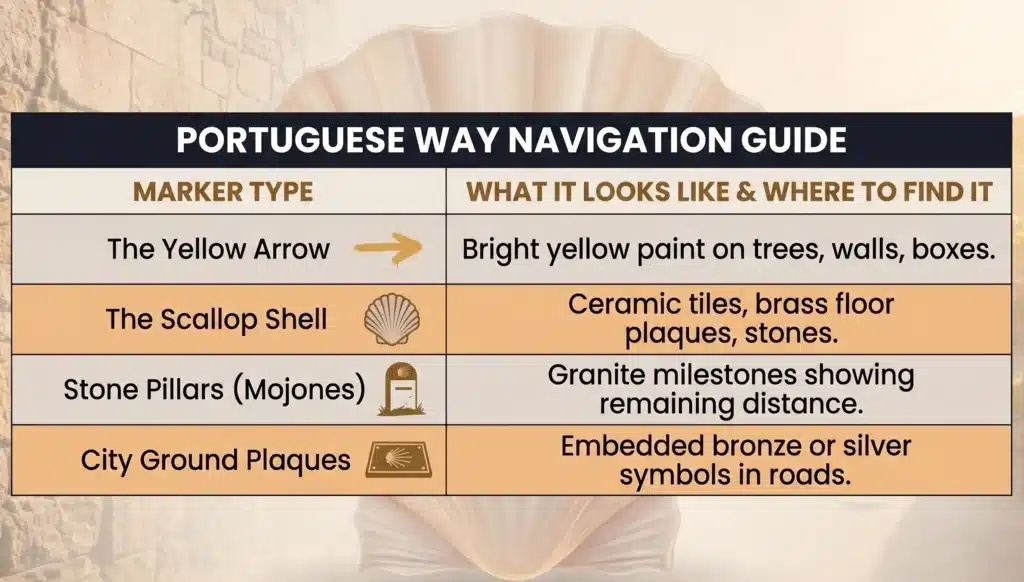
Here is a quick breakdown of the exact markers you will encounter on your pilgrimage.
The Yellow Arrow (Flecha Amarilla)
The absolute king of Camino signage is the yellow arrow. It is the most common symbol you will encounter, and it always points your way north toward Santiago de Compostela.
Historically, these were spray-painted yellow to revitalize the trail. Today, you will spot them on:
- Lampposts and electrical boxes in busy towns.
- The ground, walls, and even partially hidden in shop windows (like in Vigo).
- Stones, fences, tree trunks, and ruins out in nature.
If you are ever unsure at a fork in the road, ignore your doubts and search for the yellow arrow; it never fails.
The Scallop Shell (Concha de Vieira)
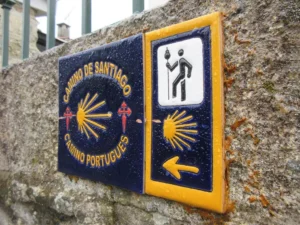
The scallop shell is the quintessential medieval symbol of the Camino. Its grooved lines represent the various European pilgrimage routes converging into one single point: the tomb of St. James.
However, using the shell as a directional trail marker can occasionally puzzle beginners. Should you walk towards the open or the closed side of the shell?
* The Rule of Thumb: Once you cross into Galicia, you generally walk toward the open rays where the lines converge.
- The Reality: Because different regions in Portugal and Spain historically mounted tiles differently, the shell can be confusing. Fortunately, it almost always appears alongside a yellow arrow. When in doubt, let the arrow take priority!
Official Stone Pillars and Milestones
As you enter the final stages of the Portuguese route, especially as you cross the border into Galicia, the trail navigation shifts to beautiful granite or concrete stone pillars (called mojones). These modern milestones securely feature ceramic tiles with the yellow shell, arrows, and a running countdown of the exact remaining distance to Santiago de Compostela.
Blue, Green, and Black Arrows
Not every arrow you see on the Portuguese roads is meant for your specific journey to Santiago. To keep your pilgrimage stress-free, keep an eye out for these:
- Blue Arrows: Pay close attention to these! Blue arrows point in the exact opposite direction of your walk. They are intended for pilgrims traveling south toward Fátima in Portugal. Do not follow them if you are heading to Santiago.
- Black Arrows on a Yellow Background: These have alternative municipal or traffic meanings and should be entirely ignored by pilgrims.
- Green Arrows: These generally mark unofficial, alternative, or scenic loop routes that are not part of the main historical trail.
Navigating Cities and Tricky Starting Points in Portugal
Finding your way through rolling hills is often easier than navigating urban areas. In large cities like Porto, Lisbon, or Pontevedra, arrows can easily blend into urban signage, traffic, and graffiti.
For instance, if you start the Camino Portugués from Porto, the starting arrows scatter all across town because multiple routes (the Central Way, the Coastal Route, and the Senda Litoral) diverge from the same cathedral.
Top Tips for Urban Camino Trails:
- Slow Down: As you enter built-up areas, prioritize road safety and pay close attention to your surroundings.
- Look Down: Look for small brass or bronze scallop shells embedded directly into the pedestrian sidewalks.
- Check Roundabouts: At large intersections, the arrow is rarely at the entrance; it is usually painted on a lamppost or curb just down the correct exiting street.
What to Do if There Are No Trail Markers?
What happens if you find yourself at a crossroads with absolutely no arrow, shell, or sign in sight?
First, take a deep breath. Usually, a marker is there, it is just not exactly where you are looking. Walk forward about 20 to 30 meters along the most logical path; often, a reassurance arrow is painted on a tree trunk or stone just around the bend.
If you are genuinely stuck, technology is your friend. You can instantly load up trusted pilgrim GPS apps such as Buen Camino or Gronze to check your live location against the official Portuguese track.
Ready to Walk the Portuguese Camino with Confidence?
Are you interested in booking your Camino but feeling overwhelmed by the planning, logistics, and route options? Let us take the stress out of your pilgrimage so you can focus entirely on the journey.
We offer tailored, highly detailed Portuguese Way planning services that cover everything from route blueprints and handpicked accommodations to luggage transfers and custom pilgrim guides. Our goal is to ensure your walk is safe, seamless, and completely unforgettable.
Why Choose Our Camino Planning Services?
- Zero Stress Navigation: We provide custom trail notes and maps so precise that you can walk with total peace of mind.
- Tailored to Your Pace: Whether you want to walk the Coastal Route, Central Way, or the Spiritual Variant, we adapt the daily stages to your fitness level and goals.
- Trusted Accommodations: Skip the early morning race for a bed. We pre-book comfortable, highly-rated lodging along the entire route.
Ready to turn your dream pilgrimage into a reality?
Explore Our Custom Portuguese Camino Booking & Planning Packages Here!